


Availability: see free time slots at a glance
The Availability view gathers, for a single day, everything a player can still book: the free time slots of each calendar with their duration and price, the activities open to participation and the bookings waiting for more players.
- Understanding what this view brings
- Using the view on a phone
- Reading the free time slots
- Showing prices and offering several durations
- Showcasing your activities
- Helping your players complete a booking
- Showing or hiding non-bookable time slots
- Checking what a subscriber sees
- Giving access to the view
Understanding what this view brings
The day and week calendars show a complete grid, including booked time slots. That is the right view for a classic, readable overview of what is happening at the club. To answer the question "where can I play tomorrow evening?", however, a player has to go through each court, column after column.
The Availability view only keeps what is still possible for the person looking at it. It applies the rules of their subscription: permitted calendars, booking horizon, permitted hours and durations, price list. Two users with different subscriptions therefore do not see the same list.
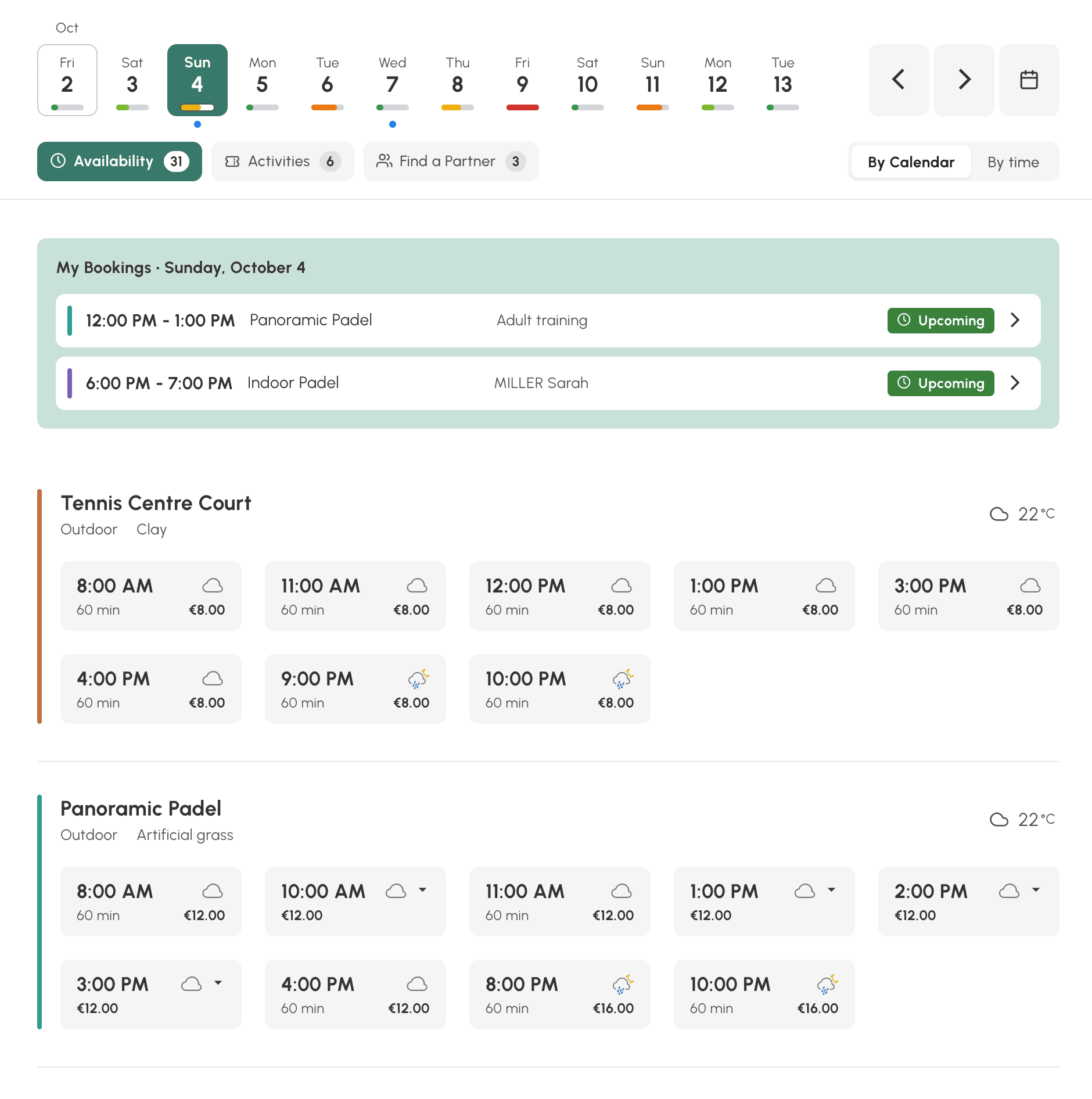
The screen reads from top to bottom:
- the custom calendar groups, if you have created any, let you filter the view by activity (Tennis, Padel, etc.) or by location (Indoor Tennis, Outdoor Padel, etc.);
- a strip of days, with an availability gauge under each day;
- three tabs, Availability, Activities and Partner Search, each with its number of results;
- the user's bookings for the day shown, then the list of time slots.
Using the view on a phone
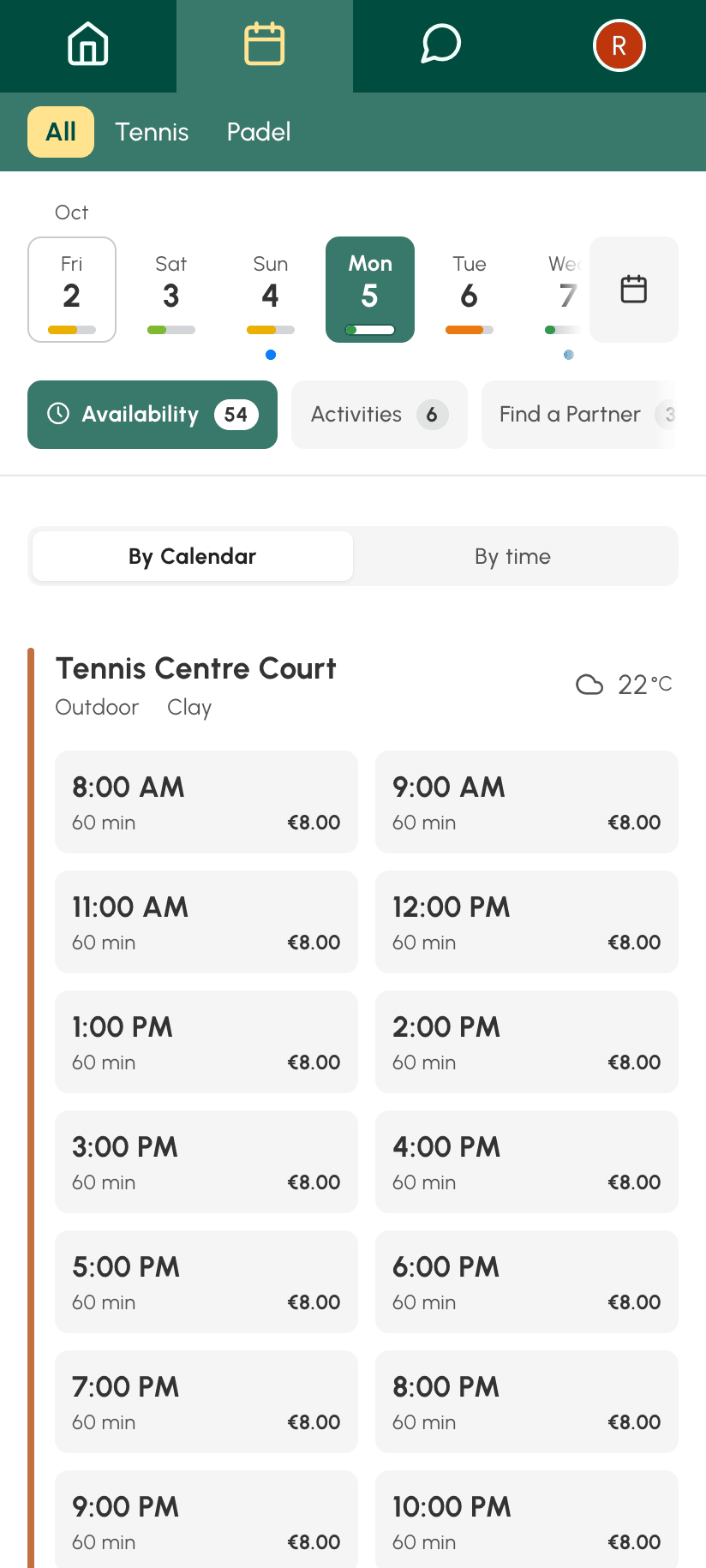
On a phone, the view keeps the same elements, stacked: calendar groups, a scrollable strip of days, tabs, then the time slots. When you scroll the list, the header folds away to leave room for the time slots, and comes back as soon as you scroll up.
Reading the free time slots
The Availability tab offers two readings, which each user chooses and finds again on their next visit:
- By Calendar: one card per court, with its free time slots for the day. Handy when you want a specific court. The calendar name opens its week view, if the profile has access to it.
- By time: the hours of the day, each with the courts free at that moment. Handy when the time matters more than the court.
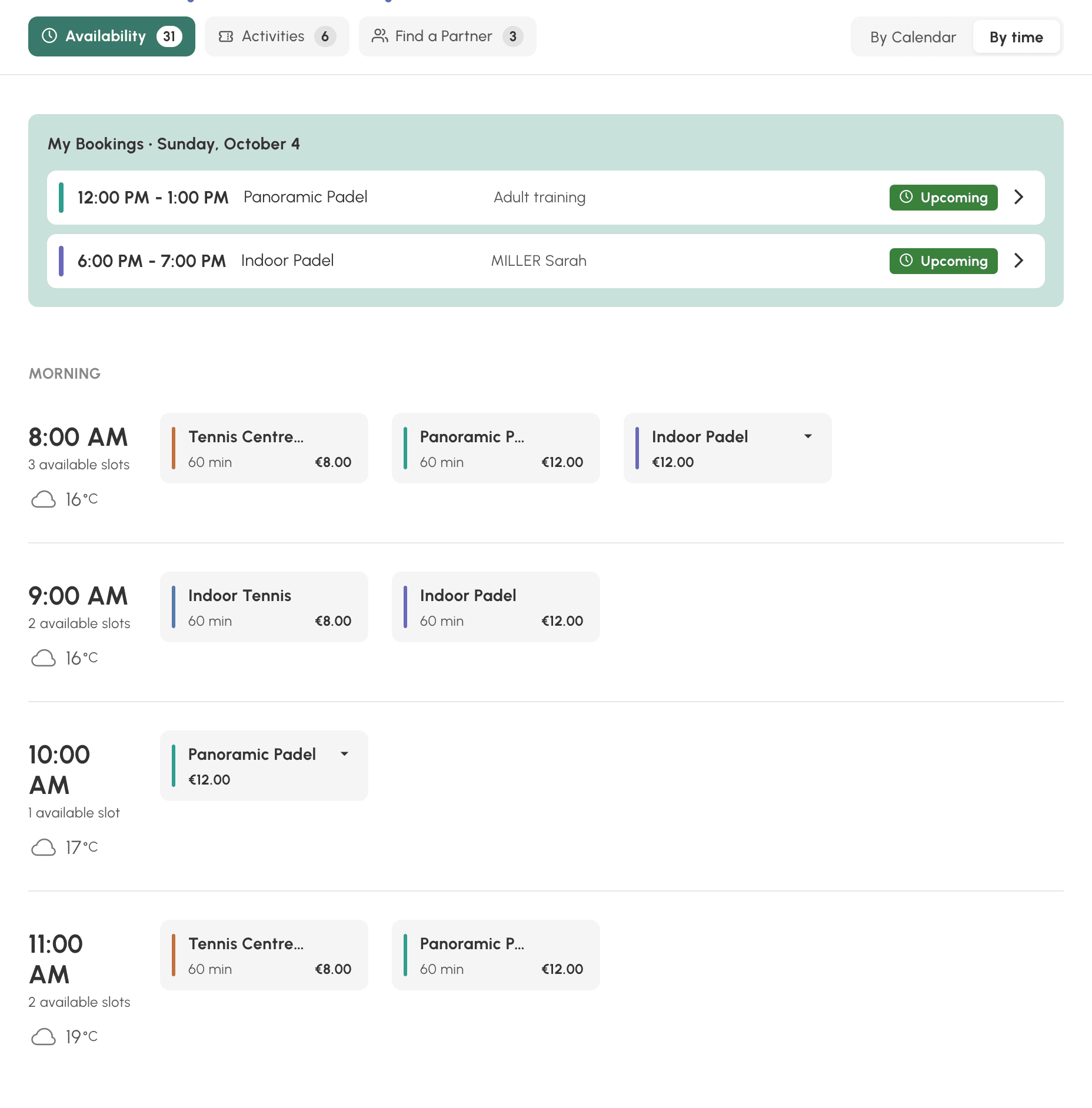
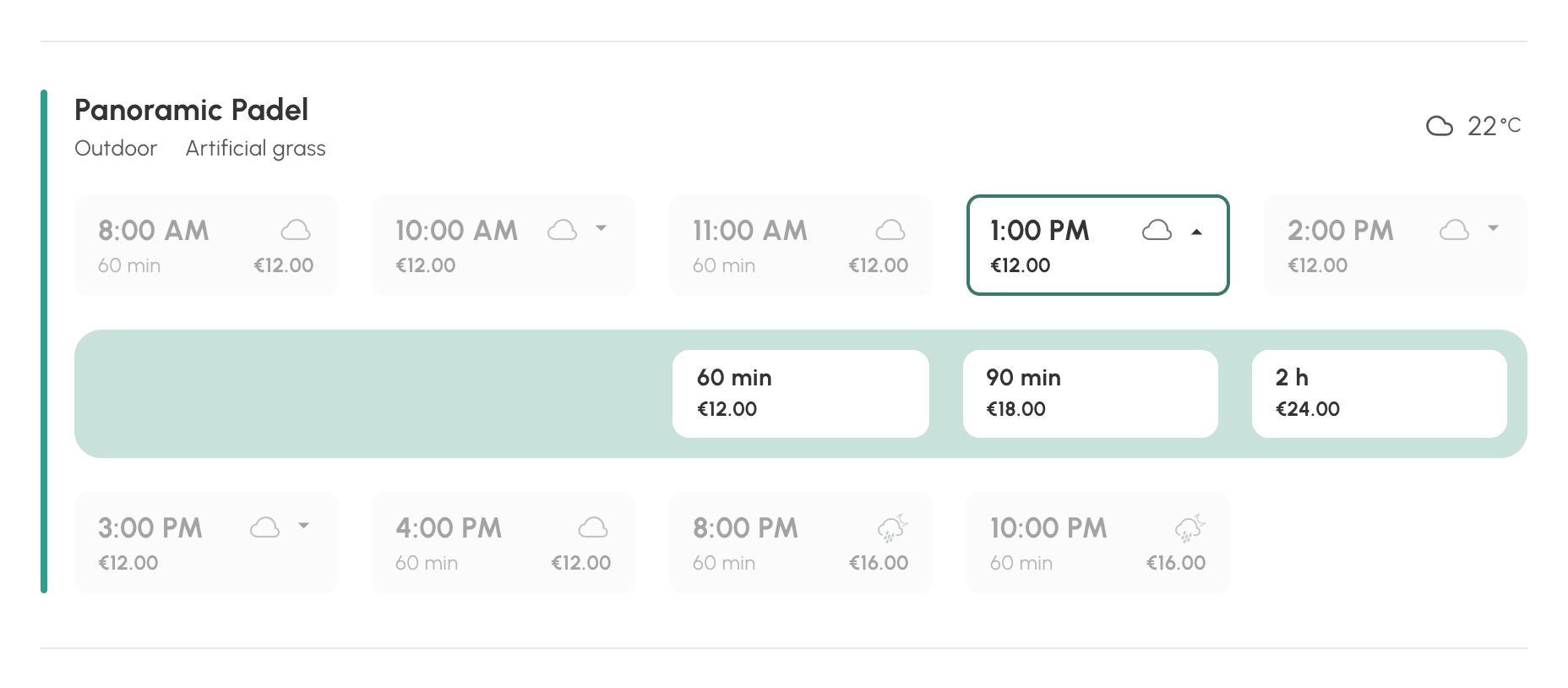
Each time slot shows its start time, its duration and its price when the booking is chargeable. A click opens the usual booking form, with the chosen duration.
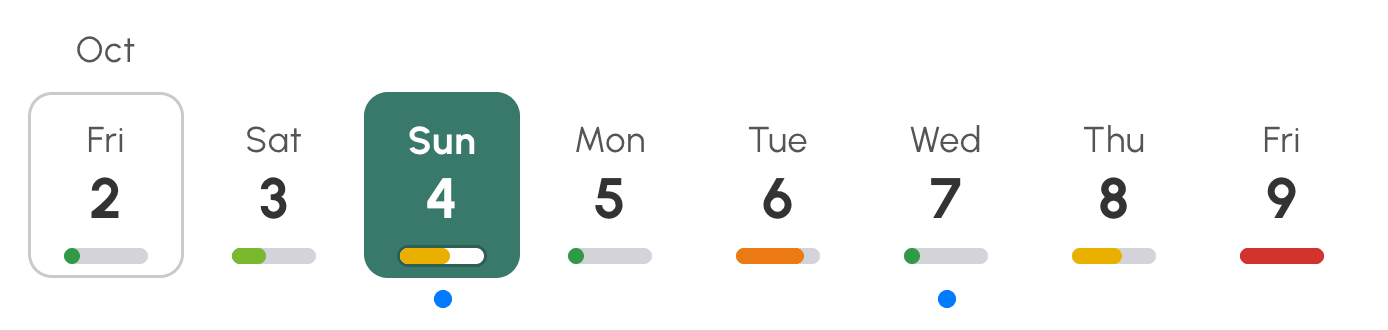
Under each day of the strip, the gauge sums up the day: Available, Almost full or Full. A blue dot marks the days on which the user already has a booking. The strip stops at the last day their subscription allows them to view.
When a day has no time slot left, the view says so and offers to go straight to the next day that has one.
Showing prices and offering several durations
The view reflects what you have set in each user's subscription. The price shown on a time slot is the one the booking form will display at the next step, for the user alone, without partners or guests. If you charge for your bookings in credits displayed as a currency amount, your players therefore see the price of each time slot before they even click, including your peak and off-peak rates. If the price depends on the participants (their number, guests, whether the booking is open, the partners' subscriptions) or on a label, the time slot shows the lowest possible price. For example, with a rate of 8 credits for singles and 5 credits from three participants, it shows 5 credits. The exact price appears in the form once the partners have been chosen.
If the subscription offers custom time slots, the same start time can be booked for several durations. The time slot then shows a small arrow and the price of its cheapest duration. Click it to expand the available durations, each with its own price.
Showcasing your activities
The Activities tab lists your participatory bookings that are open to participation: group lessons, training camps, tournaments, events. It is a showcase your users did not have until now, since they had to spot these time slots in the grid.
Each card shows the time, the duration, the name of the activity, the calendar, how full it is, the number of places left and the price. A badge marks the activities in which the user Already participating and those that are Full. A click opens the activity details, where the user joins in.
Under the activities of the day, the Upcoming section presents the following ones, up to the last day of the strip. If the day shown has no activity, it is displayed straight away.
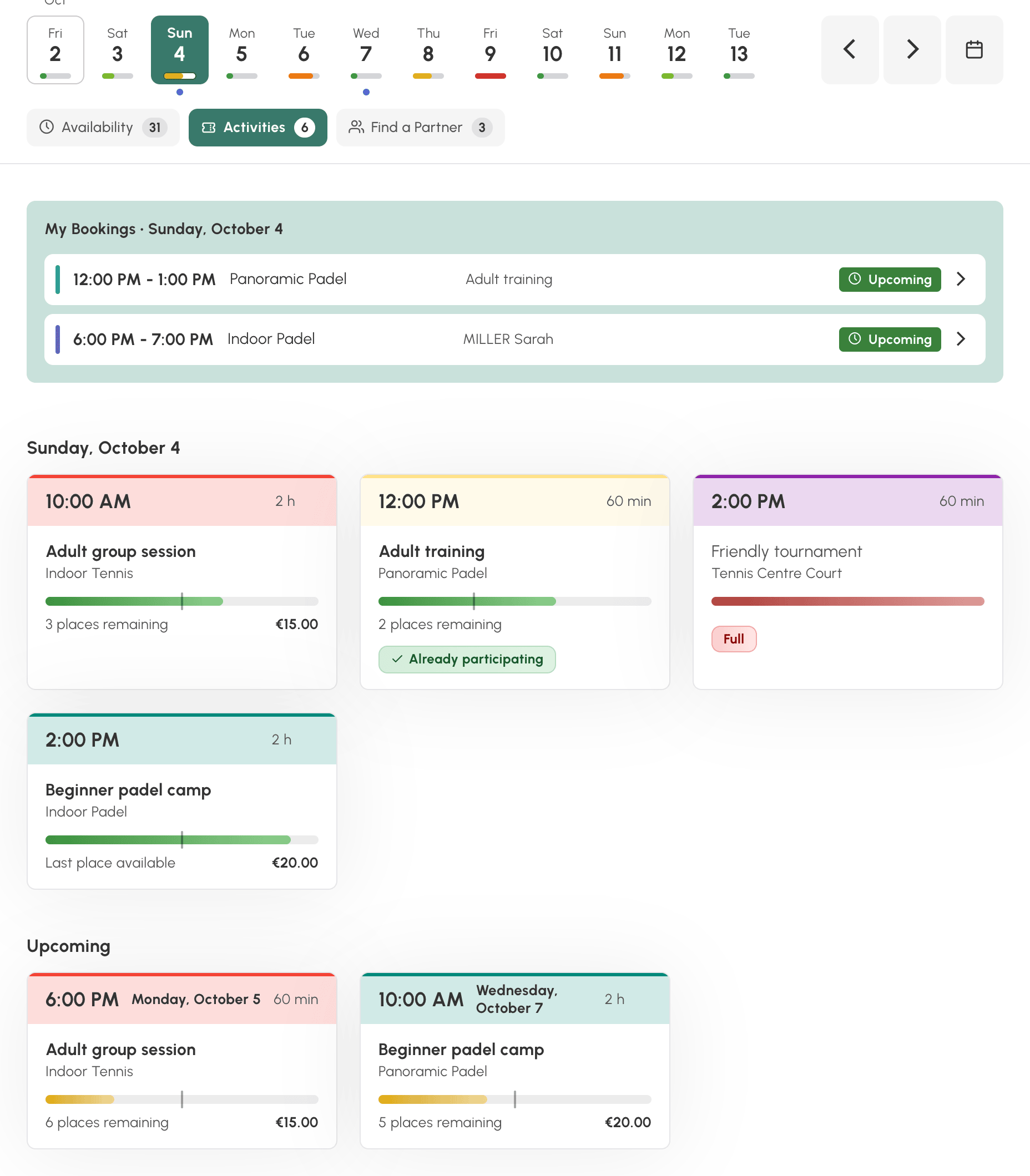
There is nothing to configure in the view: a participatory booking appears there as soon as it accepts the user's participation.
Helping your players complete a booking
The Partner Search tab lists the bookings whose owners have opened them to other players and that still have room. The user sees the time, the court, the players already taking part and the free places, then clicks on Add My Name to join them.
Names and photos follow your privacy settings, as in the standard calendars. As for the activities, an Upcoming section presents the open bookings of the following days.
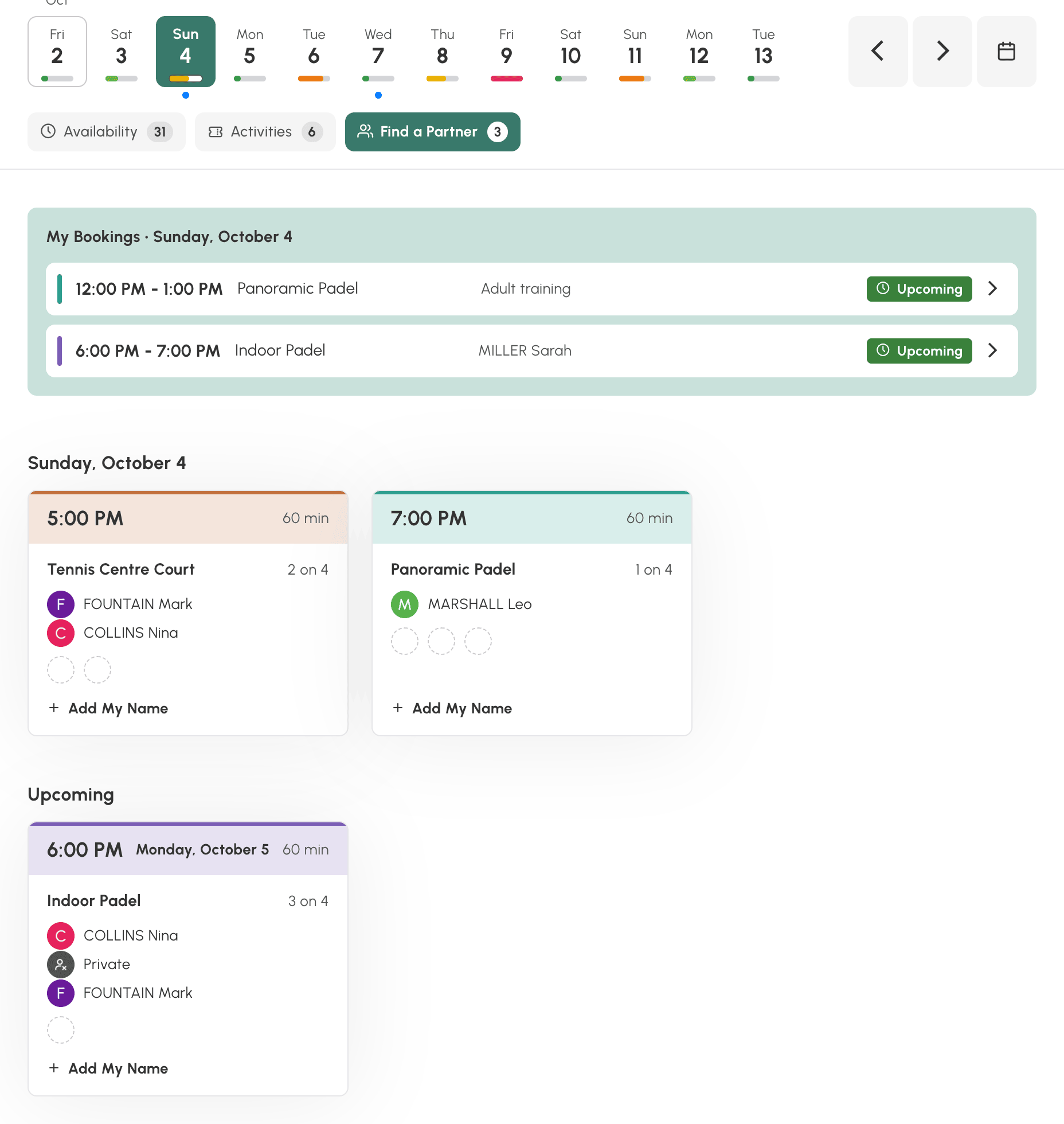
A club manager allowed to book for other users sees there all the open bookings that still have room, and views them with View Booking.
The Activities and Partner Search tabs only appear if they have something to show. When only the Availability tab is left, the tab bar disappears.
Showing or hiding non-bookable time slots
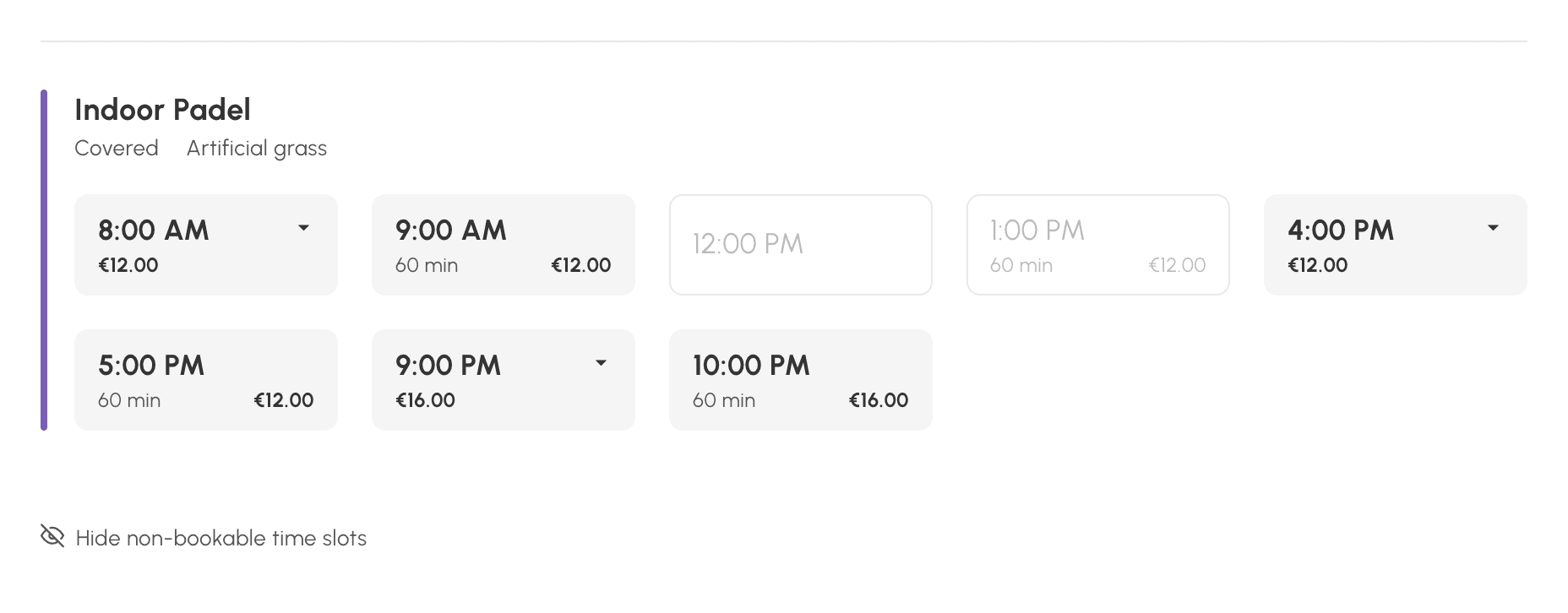
By default, the view only shows what the user can book. Free time slots that a rule of their subscription does not allow are hidden, for example a time that is not open to them.
At the bottom of the list, Show non-bookable time slots shows how many time slots are hidden and displays them, faded. They are shown for information only: clicking them does nothing. Hide non-bookable time slots returns to the short list. The choice is remembered for each user.
Calendars with nothing to offer on that day are grouped under Unavailable calendars, each with its reason: Closed, Outside the booking window or No time slots available.
A reached quota or an insufficient credit balance does not hide anything in this view. The time slots stay displayed, even if the subscription has the Hide calendars when the booking quota is reached or Hide calendars if no credit options, which only apply to the daily, weekly and monthly calendars. When the user clicks, the form shows what prevents the booking. The same applies to an activity paid in credits: it stays displayed, and joining it flags an insufficient balance.
Credits are checked last. A player who has reached their quota and has an insufficient balance therefore sees the quota message. They do not see a prompt to buy credits that they could not use right away.
Checking what a subscriber sees
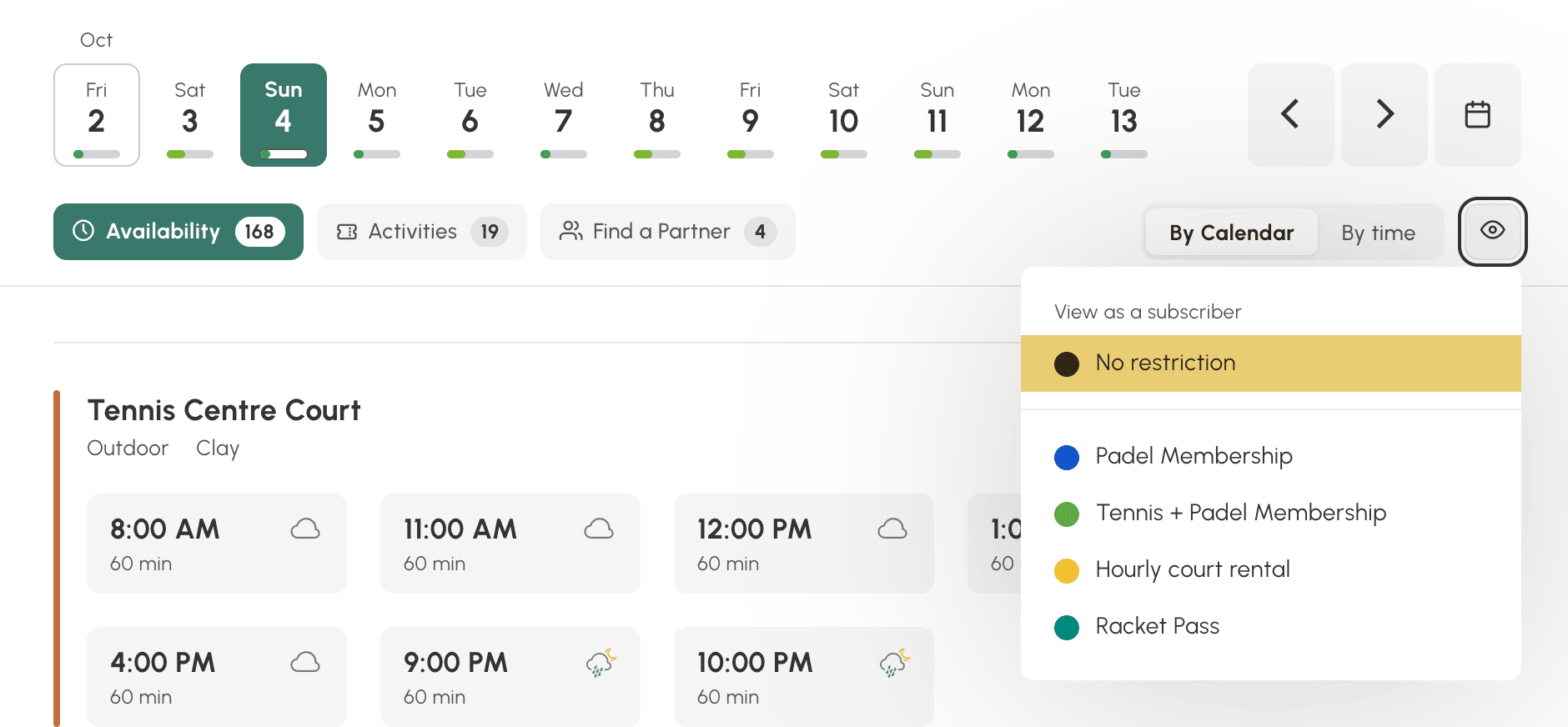
A calendar administrator sees the view without restriction, outside the limits of a subscription. To check what your rules actually produce, the View as a subscriber button shows the view as a subscription gives it to its users.
- Open the Availability view.
- Click on View as a subscriber, to the right of the tabs.
- Choose a subscription from the list.
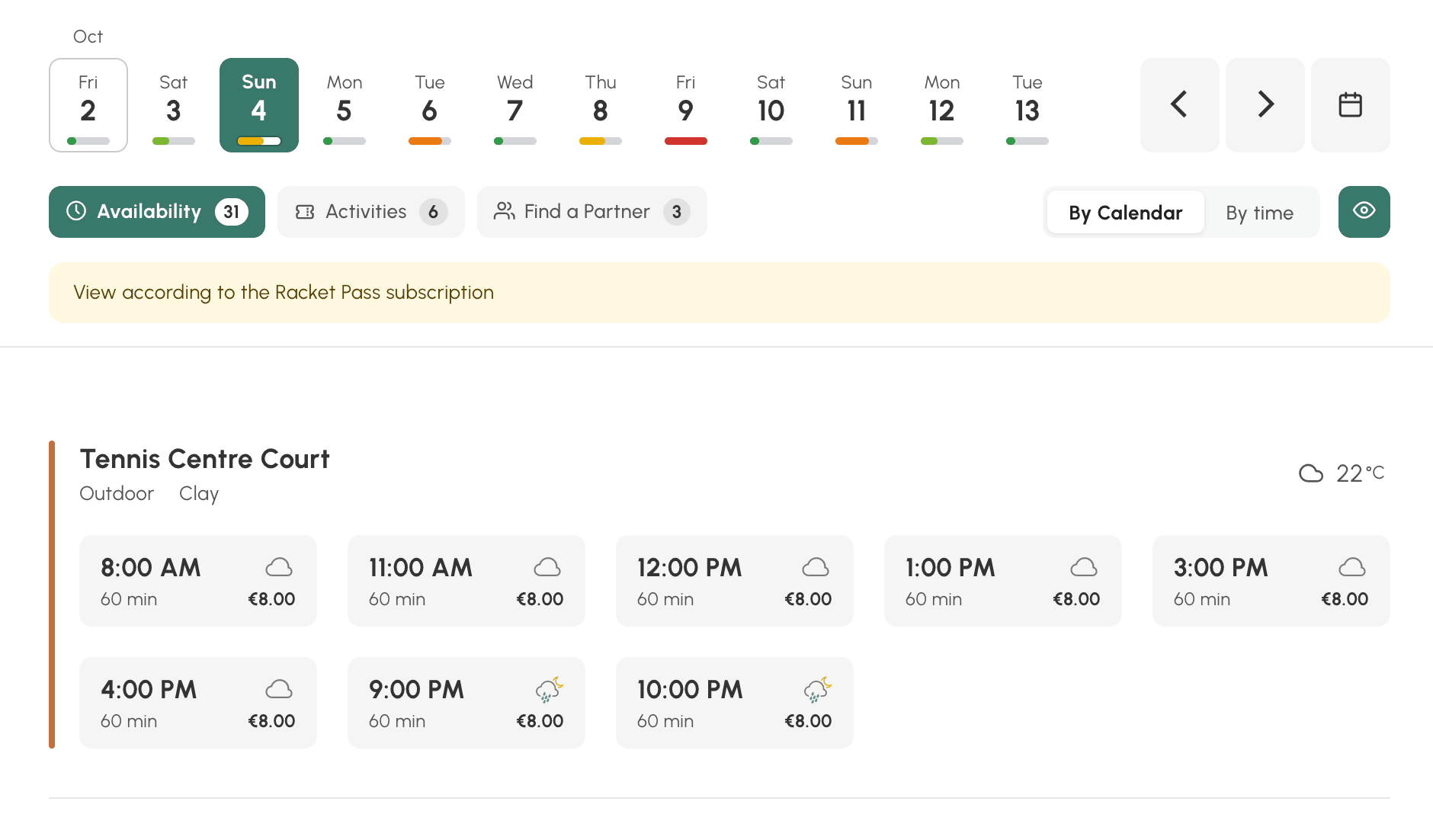
A banner is a reminder of the simulated subscription. The time slots, the durations and the prices are those of that subscription. It is the quickest way to check a rule you have just changed: booking horizon, forbidden calendars, custom time slots, price.
To return to your own view, choose No restriction in the same menu.
Giving access to the view
This view is enabled by default for all users. If needed, you can customise access by profile, as for the other views. For example, you can open it to your players and keep the daily grid for the front desk team, or the other way round. Another example: a "Rental" profile with only the Availability view available, while members have access to all views.
- Go to Administration›Users›Access Rights›Profiles & Roles and open a profile.
- In the Booking tab, tick Availability.
- In Default view, choose the view that opens when the user reaches the booking page: Per day, By Week, Per month or Availability.
- Click Save.
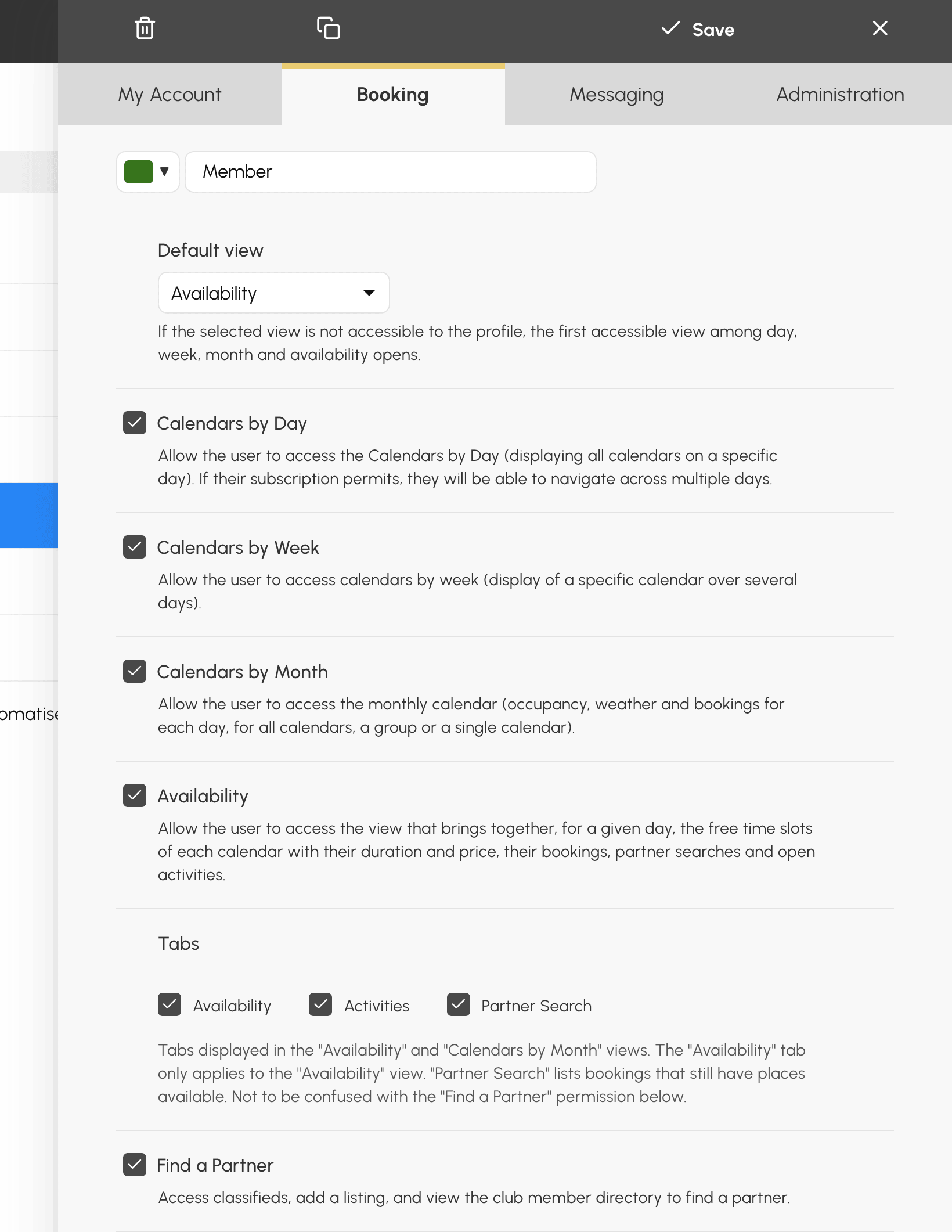
The Tabs block, below the views, sets which tabs the profile sees:
- Availability: the free time slots tab, specific to the Availability view. This box only appears if the Availability right is ticked;
- Activities and Partner Search: these two tabs apply to the Availability view and to the log of the monthly view.
The block appears as soon as the profile has access to the Availability view or to the monthly view. A hidden box keeps its state. For example, untick Activities and Partner Search for a "Rental" profile that does not need to join activities or complete bookings.
When the view was enabled, the right was given to profiles that already used the daily or weekly calendars. Their default view remained Per day. Nothing changes for your users until you modify this setting.
If a profile's default view is not accessible to it, the first allowed view opens instead.
Users find the view in the menu, under Availability, next to the daily, weekly and monthly calendars. In the booking panel of the navigation bar, it is the magnifying glass button.
